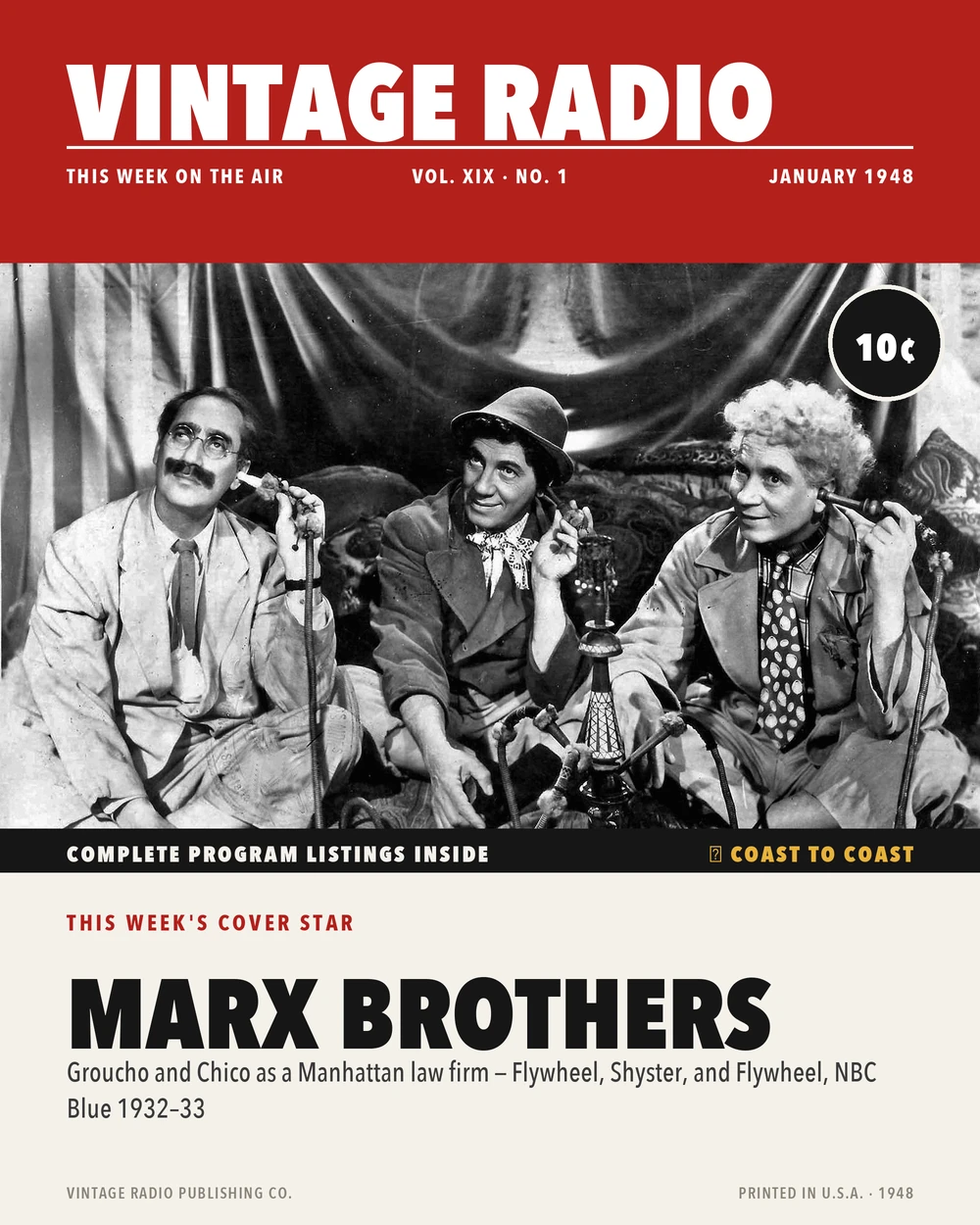
Marx Brothers
The Lawyer Who Kept Changing His Name
The Marx Brothers came to radio in the fall of 1932 with a premise that sounds exactly like something Groucho would have invented: a shady law firm run by one Waldorf T. Beagle and his assistant, Emmanuel Ravelli. Groucho played Beagle — all fast talk and legal double-dealing — and Chico played Ravelli, the blissfully incompetent sidekick. The show launched on the Blue Network on November 28, 1932, in a Monday night half-hour at 7:30, sponsored by Standard Oil and Colonial Beacon Oil advertising Esso Gasoline.
It didn't stay "Beagle" for long. After three episodes, a real New York attorney named Morris Beagle filed a $300,000 lawsuit, claiming the show had slandered his name and was damaging both his health and his practice. He also reported that listeners were calling his law firm and, when he picked up, asking "How's your partner, Shyster?" before hanging up. The show became Flywheel, Shyster and Flywheel starting with episode four. The in-show explanation was handled with characteristic absurdity: Miss Dimple, the office receptionist, announced that the boss had gotten a divorce and changed his name back to Flywheel. Flywheel himself clarified the situation briefly — "Shyster ran away with my wife" — and the matter was considered settled.
Harpo Marx did not appear in either radio series, and the reason is straightforward: he didn't speak in his film characterizations, and radio is entirely speaking. Zeppo was also absent, partly because he was on the verge of leaving the act entirely, and partly because early drafts that had written guest appearances for both Harpo (using horn honks and sound effects) and Zeppo were eventually dropped. According to biographer Stefan Kanfer, Harpo was paid a weekly salary specifically for not appearing on the show.
The Esso Comedy Block
Flywheel, Shyster and Flywheel didn't exist in isolation — it was the Monday-night anchor of a broader programming experiment called Five Star Theater. Standard Oil's advertising agency, McCann-Erickson, built the variety block as a direct competitive response to the Texaco Fire Chief program, which starred Ed Wynn on the NBC Red Network starting April 26, 1932, and had attracted over two million regular listeners and a CAB rating of 44.8%. Standard Oil wanted its own radio showcase, and McCann-Erickson designed a five-nights-a-week lineup spanning multiple networks: symphonic music on Tuesdays, drama on Wednesdays, opera on Thursdays, and Charlie Chan closing out the week on Fridays. The Marx Brothers opened every week on Monday. The block wasn't just selling Esso Gasoline — its five nightly programs were chosen to dramatize Esso's five unique properties, including Essolube Motor Oil and a refining process known as "hydrofining." The Marx Brothers' Monday night went out to thirteen network affiliates across nine Eastern and Southern states.
Each episode of the Marx Brothers show ran roughly fifteen minutes of comedy drama, followed by ten minutes of orchestral music between acts, and closed with a sixty-second promotional skit performed by Groucho and Chico — stepping out of their Flywheel and Ravelli characters to pitch Esso and Essolube directly to the audience. Whatever the comic anarchism of the main body, the sign-off was product placement, straight and simple.
Getting the Scripts Written
The logistics of producing the show were genuinely chaotic. Because Groucho, Chico, and writers Nat Perrin and Arthur Sheekman were all living and working in Hollywood at the time, the early broadcasts required a three-day train journey from Pasadena to New York each week, followed by the return trip. The first episode's script was written during that initial train ride. The show broadcast from NBC's flagship station WJZ in New York for the early episodes, then relocated mid-run to an RKO Pictures sound stage in Los Angeles — NBC had no West Coast facility at the time — before returning to WJZ for the final episodes.
The writing staff was Perrin, Sheekman, George Oppenheimer, and Tom McKnight. Perrin, who had gotten his foot in the door at Paramount in 1931 by presenting Groucho with a forged letter of introduction purportedly from playwright Moss Hart, was the central figure. He recalled in a 1996 interview that the writers had "their hands full turning out a script each week" and had to enlist Oppenheimer and McKnight to keep up. Sheekman, whom Groucho called "The Fastest Wit in the West," had known the brothers since 1926, when he covered their touring production of The Cocoanuts as a Chicago critic. He'd already ghostwritten Groucho's humor book Beds and contributed uncredited jokes to Horse Feathers. Perrin sometimes stood in for Chico at rehearsals when Chico was late — which was apparently a recurring situation.
Mary McCoy played Miss Dimple, the law office receptionist who answered phones and shuffled clients in and out. It's also thought, though unconfirmed, that a young Broderick Crawford appeared in various supporting roles.
The Film Connection
The show and the Marx Brothers' film work were thoroughly tangled. According to Perrin, the series "liberally lifted material" from earlier films — several specific episodes recycled plots and dialogue from Animal Crackers, Monkey Business, and The Cocoanuts. Episode 17 drew on the stolen-painting plot from Animal Crackers. Episode 23 reused the stolen-diamond plot and Groucho's "seven-cent nickel" lines from the same film. Episode 19 took its plot from The Cocoanuts, and Episode 25 leaned on Monkey Business. Episode 26, the final episode and the only complete recording to survive, lifted scenes nearly unchanged from Animal Crackers, with Flywheel impersonating a famous explorer and being invited to the Long Island home of socialite Mrs. Rivington.
Traffic moved in the other direction too. No fewer than 15 routines from Flywheel, Shyster and Flywheel were later used in Duck Soup, and the radio writers received screen credit on that film for "additional dialogue." The Flywheel name itself had a longer life than the show: Groucho's character name was recycled for the 1941 MGM film The Big Store, in which he played "Wolf J. Flywheel," a detective.
Despite ratings the sponsors considered only moderate — the show ended the 1932–33 season with a CAB rating of 22.1%, placing it 12th among evening programs, ahead of The Shadow and The Adventures of Sherlock Holmes but less than half of the Fire Chief's 44.8% — the show was not renewed. The four Marx Brothers were ready to return to films, and Standard Oil had hoped for stronger numbers given the 7:30 timeslot. The first series concluded on May 22, 1933, after 26 episodes.
A second series followed on CBS beginning March 4, 1934, sponsored by American Oil. In this one, Groucho played Ulysses H. Drivel, a reporter, and Chico played a character named Penelli. The second series, also known as The Marx of Time, ran for eight Sunday evenings at 7:00 before ending on April 15, 1934. Additional performers included Elmer Feldkamp, Terry Shand, and Freddie Martin's Orchestra. No recordings from this series are known to survive.
What Survived and What Came After
Nat Perrin put the show's core problem plainly in a later interview: the scripts "would go very well in the studio, but when it got to the radio, it was still just talking and it was deadly." Groucho's visual comedy — his walk, his painted moustache, his physical timing — simply didn't carry over to audio. That honest assessment didn't stop people from seeking out the show decades later.
Michael Barson, working in the Deposit Collection at the Library of Congress in the early 1980s, found 25 of the 26 original scripts filed under "unpublished dramas." He interviewed Perrin and published the scripts along with an essay and the interview through Pantheon Books in October 1988. That same year, comedian Steve Allen praised the recovered material, saying the scripts "hold up very well indeed and are, in fact, superior to the material that was produced for the Eddie Cantor, Rudy Vallee, Joe Penner school" of radio comedy. In October 1988, NPR aired an 18-minute recreation of scenes from the show in markets including Chicago, Los Angeles, and Dallas, using Arena Stage actors from Washington, D.C. — the first time any Flywheel material had been heard on American airwaves since 1933.
Actual audio from the original run is scarce. Three fragments turned up after 1996: a five-minute excerpt from Episode 24 (the "bus scene," May 8, 1933), the second half of Episode 25 (May 15, 1933), and the complete Episode 26, "The Ocean Cruise" (May 22, 1933) — the only intact surviving episode. That last recording was broadcast by BBC Radio 4 on December 27, 2005, in a production by Stephen Garner.
The BBC had already adapted the scripts for its own series. Producer and director Dirk Maggs ran the BBC Radio 4 adaptation across three series between 1990 and 1992, performed before a live studio audience, with scripts adapted for a British audience by Mark Brisenden. The cast featured soundalikes in character-appropriate makeup: Michael Roberts as Flywheel and Frank Lazarus as Ravelli, with Lorelei King playing all female roles and guest appearances from Spike Milligan and Dick Vosburgh. Music was arranged and conducted by David Firman. The second series won the Gold Medal at New York's International Radio Festival in 1992, and the adaptation was later picked up for broadcast in the United States through NPR. In 2010, a stage musical based on the same radio scripts, The Most Ridiculous Thing You Ever Hoid, debuted at the New York Musical Theatre Festival to strong reviews.